 Intranet

At the second edition of the Sport for Sustainable Development Summit, the Finance in Common Coalition reported nearly USD 2.5 billion in sport-related investments toward its USD 10 billion commitment. It also shared progress on the Global Sport Impact Fund initiative and presented new joint research on Africa’s sport sector.
Dakar, Senegal, November 2026
On 31 October 2026, on the eve of the opening of the Dakar 2026 Youth Olympic Games, President Bassirou Diomaye Faye hosted the second Sport for Sustainable Development Summit. He was joined by Heads of State and Government, including President Mohamed Ould Cheikh El Ghazouani of Mauritania and H.S.H. Prince Albert II of Monaco, as well as IOC President Kirsty Coventry. Leaders of development banks, international financial institutions and investors also took part. Their discussions centred on one question: how to mobilise capital for sport and make sure major events leave lasting economic and social benefits.
Two years after the Paris 2024 Summit, Dakar gave the Coalition its first real opportunity to take stock of its agenda. It could show where the collective investment commitment stands. It could report progress on the Global Sport Impact Fund initiative. And it could present new research designed to give investors and policymakers a sharper picture of Africa’s sport sector.
USD 10 billion commitment: first results
Makhtar Diop, Managing Director of IFC, opened the high-level financing session with a keynote address. He recalled the joint commitment of up to USD 50 million made by IFC and Proparco, AFD Group’s private sector subsidiary, in Helios Sports and Entertainment Group (HSEG), the first pan-African investment vehicle dedicated to sport and entertainment. He also called for financing that extends beyond elite performance to school sports facilities and athletes’ career transitions, including into entrepreneurship.
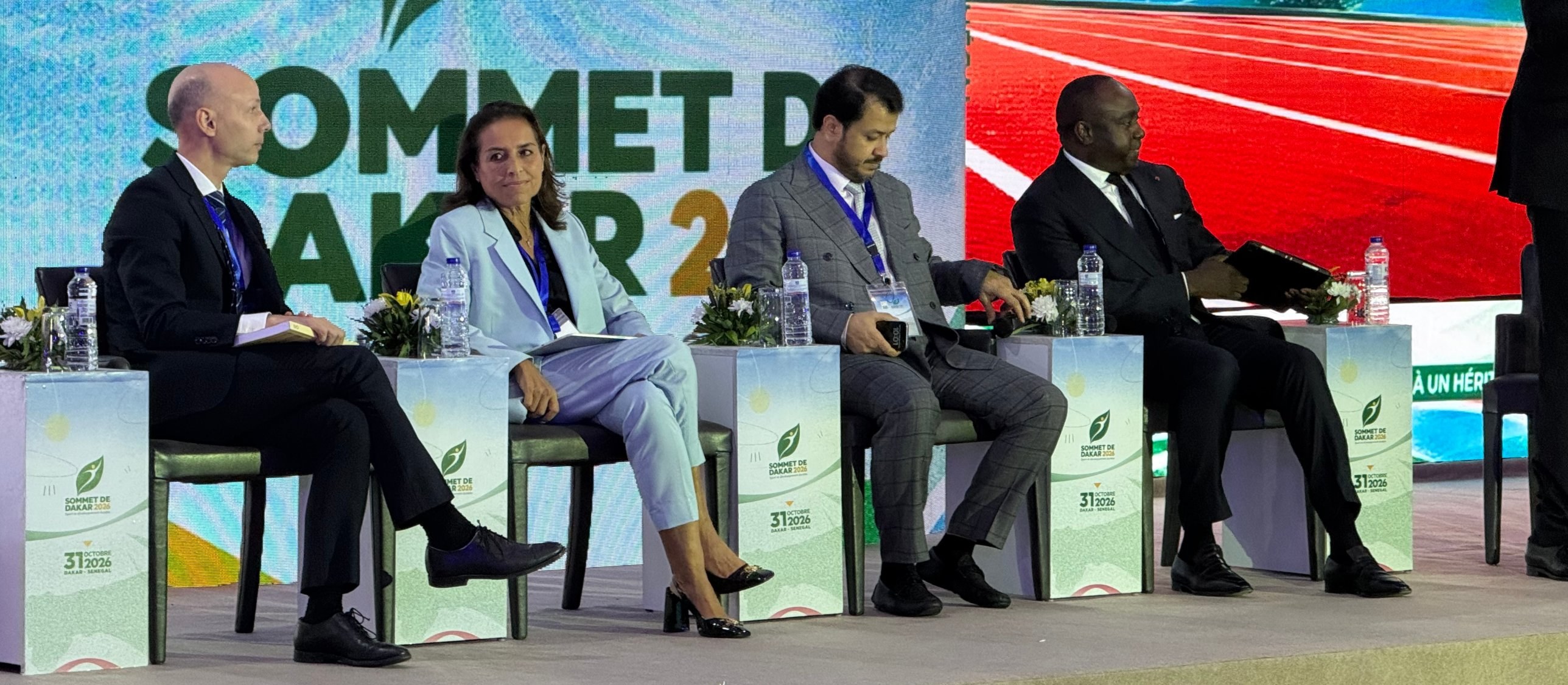
A panel discussion followed, featuring Antonella Baldino, CEO of Istituto per il Credito Sportivo e Culturale (ICSC) and representative of one of the Coalition’s Co-Chairs. She was joined by Thomas Mélonio (AFD), Ibrahim Al-Bakri (Saudi Sports Investment Forum) and Ibrahim Magassa (Algest Investment Bank). The panellists examined how public development banks, international financial institutions and private investors can work together to scale financing for sport. Their focus was on projects that combine financial sustainability with tangible development outcomes.
At the Paris 2024 Summit, the Coalition pledged to invest at least USD 10 billion by 2030 in sustainable sport infrastructure and sport-for-development initiatives. Antonella Baldino presented the first results against that pledge. An initial mapping among participating members has identified nearly USD 2.5 billion in sport-related investments. These figures are preliminary and still being consolidated, but they provide a baseline for tracking progress toward the 2030 target.
Building on this exercise, the Coalition will strengthen investment tracking and harmonise reporting across its member institutions. It will also go further than measuring volumes. The aim is to document what these investments actually deliver in employment, education, health, infrastructure and social inclusion, so that the case for investing in sport rests on demonstrated results.
Global Sport Impact Fund: structuring and pipeline advance
The Summit was also an opportunity to share progress on the Global Sport Impact Fund (GSIF), an initiative under development within the Coalition. The proposed fund would use a blended finance approach to mobilise public and private capital for sport projects with strong development potential, and to help address financing gaps in the sector.
Work on the Fund’s possible legal and institutional arrangements is progressing. In parallel, a preliminary pipeline of projects is being assessed. The projects come from a range of geographies and reflect different business models, investment profiles and development objectives.
The next steps will focus on refining the structuring options, further assessing the pipeline and engaging with prospective investment partners.
New research on Africa’s sport economy
Thomas Mélonio, Chief Economist and Executive Director of Innovation, Strategy and Research at AFD, presented preliminary findings from Unlocking the Potential of Sports in Africa. Several Coalition members and partners produced the study together, and it addresses a long-standing shortage of reliable data on the sector. It gives investors and policymakers a solid basis for identifying opportunities, allocating capital and measuring the development returns of sport.
Drawing on research across African countries, the study looks at how many people take part in sport, what infrastructure they can access and what economic opportunities the sector creates. It also assesses sport’s wider contribution to health, education and employment. The early findings confirm persistent gaps in infrastructure and access across the continent. They also highlight that facilities only deliver lasting value when they are backed by sustainable management models and thriving local sport ecosystems.
The study will be published on 4 November 2026 by AFD, the World Bank Group and the IOC, in partnership with the Development Bank of Southern Africa (DBSA).
Next milestone: Bangkok 2027
The 6th Finance in Common Summit will take place from 31 March to 2 April 2027 in Bangkok, Thailand. It will be the first Finance in Common Summit held in Asia. The Coalition will use it to review progress on its commitments, broaden dialogue with public development banks and investment partners in a new region, and scale up financing for sport.
From Paris 2024 to Dakar 2026 and Bangkok 2027, the Coalition’s priority remains the same: turning commitments into investment, and investment into measurable impact.
About the Finance in Common Coalition for Sustainable Development through Sport
The Coalition brings together public development banks, international organisations and strategic partners to increase investment in sport as a driver of sustainable development. It is co-chaired by AFD, ICSC and JICA, and its Secretariat is hosted by Sport Impact. The Coalition mobilises financing, develops innovative investment instruments and strengthens knowledge and impact measurement across the sector.
Its members are the Agence Française de Développement (AFD), the Association of Development Financing Institutions in Latin America and the Caribbean (ALIDE), the Association of National Development Finance Institutions in Member Countries of the Islamic Development Bank (ADFIMI), Bancóldex, the Banque Ouest Africaine de Développement (BOAD), CAF - Development Bank of Latin America and the Caribbean, the Caisse de Dépôt et de Gestion (CDG, Morocco), the Caisse des Dépôts et Consignations (CDC, France), Cassa Depositi e Prestiti (CDP, Italy), the Development Bank of Rwanda (BRD), the Development Bank of Southern Africa (DBSA), the Istituto per il Credito Sportivo e Culturale (ICSC) and the Japan International Cooperation Agency (JICA).
They are joined by the International Olympic Committee (IOC), the International Paralympic Committee (IPC), UNESCO, the Deutsche Gesellschaft für Internationale Zusammenarbeit (GIZ), the Dakar 2026 Youth Olympic Games Organising Committee, the European Network of Academic Sports Services (ENAS), Laureus Sport for Good and the Yunus Sports Hub.